Agriculture
The Remuda
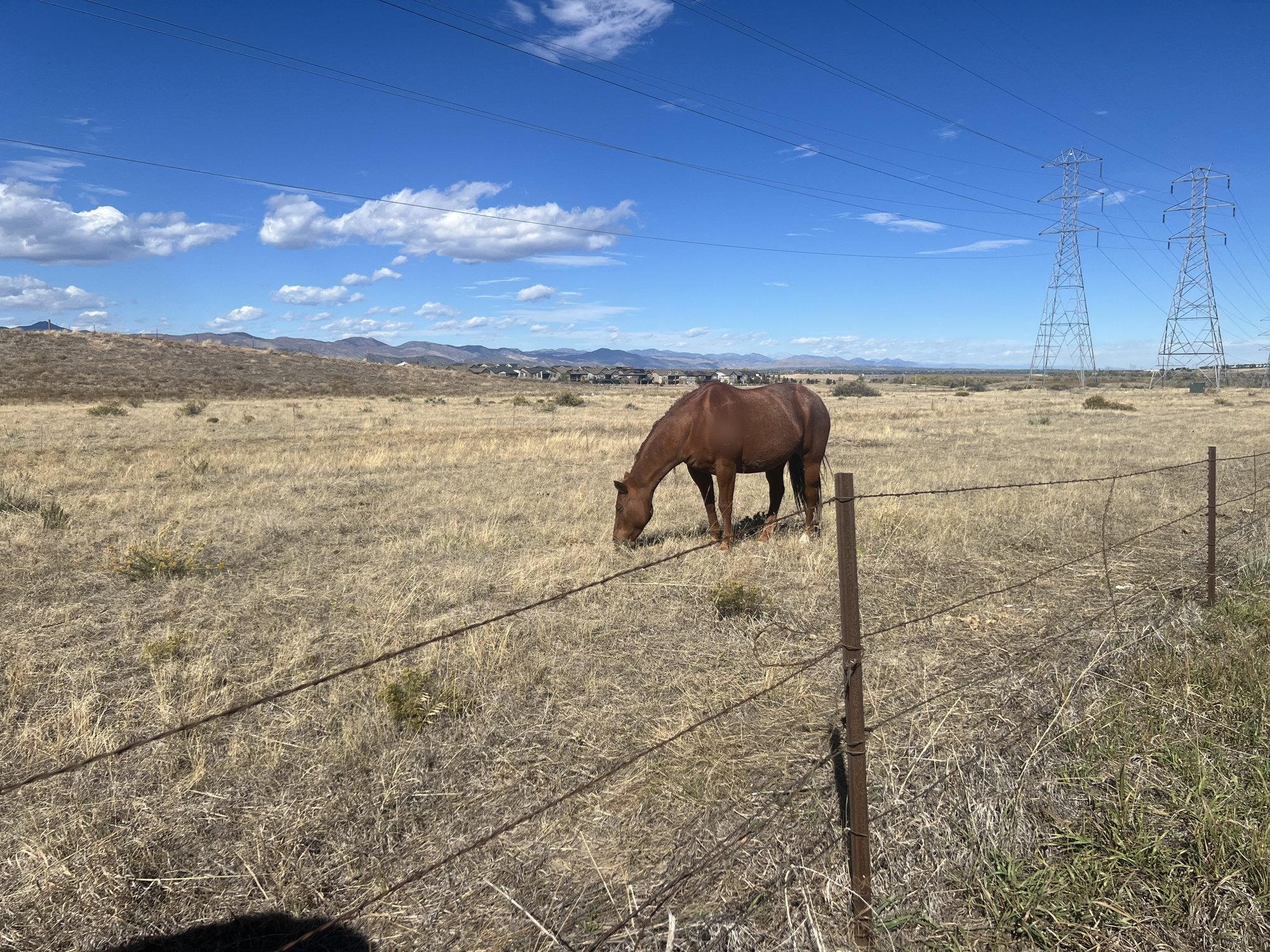
I pulled over last week for three horses grazing a dry fall pasture behind a barbed-wire fence. They weren't mine, but I couldn't drive past. A palomino wandered right up to say hello while the others kept their heads down in the grass. Behind them, rooftops were climbing the hill, and power lines ran across the sky.
Smack dab in the middle of new construction, there they were, doing what horses have done on this land for generations: grazing, resting, waiting for work.
It got me thinking about the remuda.
A change of horses
Remuda is a Spanish word that means, roughly, a remount or a change of horses. It's the ranch's working string of saddle horses, and it came north with the Spanish horsemen and the vaqueros who taught the American West how to work cattle.
The idea is simple. No single horse can do a cowboy's job day after day. So every rider had a string of his own, and he rotated through them to keep each one fresh and sound.
The remuda on the trail
On the great cattle drives, each cowboy needed about six horses, and sometimes up to ten. He might change mounts once a day or even twice. A drive could cover up to 30 miles a day for weeks on end, pushing cattle hundreds of miles to the railhead.
The whole remuda, often 60 to 100 head, traveled alongside the herd, grazing as it went. It was kept apart from the cattle, because longhorns could hurt a horse, and a horse on the move could spook a herd.
The wrangler
Someone had to keep all those horses. On the trail, that was the wrangler. In Spanish, the man in charge of the remuda was the remudero. Farther north on the Plains, cowboys turned the Spanish caballada into "cavvy."
The wrangler's job was to know every horse by sight. He let them graze freely so they stayed strong, gathered them each morning so the riders could catch their mounts, and brought the whole string to the noon camp for a fresh change. With no pens on the trail, he held them in a rope corral. If a horse went missing, he tracked it down. A drive only moved as long as its riders stayed mounted, and that was on him.
The remuda today
The great drives lasted only about 20 years. Railroads reached Texas, so cattle could ship from home. Barbed wire fenced the open range, quarantines against Texas fever closed the trails, and homesteaders settled the land in between. Then the brutal winter of 1886–87 killed cattle by the thousands across the Plains. Ranching changed for good, from open range to fenced, managed land with hay put up for winter, much like the pasture where I found these horses.
The remuda didn't go anywhere, though. On big working ranches, cowboys still change horses two or three times a day, because there are places a truck simply can't go. Since 1992, the American Quarter Horse Association has given a Best Remuda Award to ranches that raise outstanding strings of working ranch horses.
A good remuda is built over generations. It takes years of breeding, starting colts, and knowing each animal, and it can't be bought in a single sale.
What the remuda teaches
I think that's why those three horses stopped me. The houses behind them will go up in a season. A remuda, and the ranch around it, takes a lifetime.
The remuda is a lesson in stewardship. You don't ride one horse into the ground. You rotate, you rest, you know each one, and you plan for the long haul. Good ranches have always worked that way, with their horses, their grass, and their people.
As open land gives way to rooftops, I hope we keep a little of that wisdom, and a few more pastures where a palomino can still walk up to the fence and say hello.
Jodi Ashton, Founder & Managing Director
Photo: A palomino at the fence, with a sorrel grazing behind.