Our vision›Preservation equity
Preservation equity.
A family heirloom isn’t frozen in a display case. It’s cared for, used, improved where it needs it, and handed on. That is how we believe America’s best businesses, farms, and ranches should be owned.
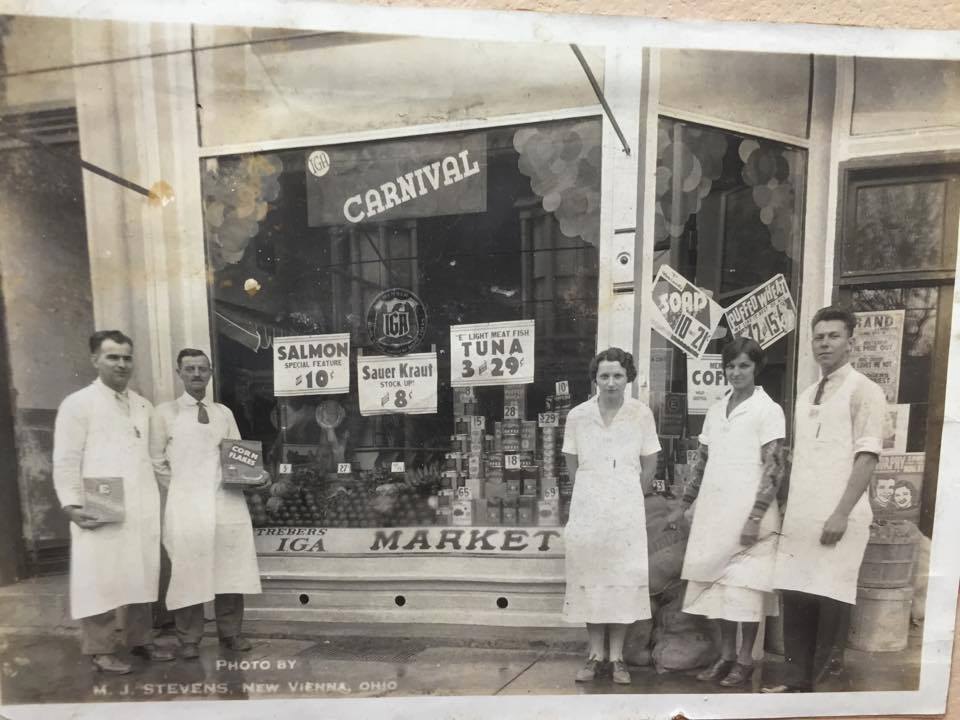
Streber’s Market, New Vienna, Ohio, 1934
A definition
What preservation equity means.
What do you think of when you hear the word heirloom? Maybe a grandmother’s ring, a well-worn family Bible, or the table where every holiday meal was served. For us, an heirloom is something to protect, to value, to hold, and to preserve. It isn’t locked away. It’s used, cared for, and handed to the next person who will love it just as much.
That is exactly how we think about the businesses, farms, and ranches we own.
Preservation equity is ownership that treats a business like a family heirloom: we protect it, keep it, value it, and pass it on, improving what needs improving while preserving the very essence of what it is.
Put more formally, preservation equity is the ownership of essential, founder-built businesses and working land with the intent to protect, keep, and pass them on, investing to improve them while preserving their essence, financed with institutional discipline and a defined path home for the capital.
Protect it. Keep it. Improve it. Pass it on.
Where the idea comes from
The store was the heirloom.
In 1931, with the country deep in the Great Depression, Kroger decided New Vienna, Ohio, wasn’t worth a store. My great-grandfather, Gleason Streber, disagreed. He borrowed $25 for the till and opened Streber’s Market on his own. It took real courage to bet on a small town when families were counting every dollar, and that courage says a great deal about who he was.
The store became our family’s heirloom. It passed from him to my grandpa, then to my dad and my uncle, and I grew up opening its doors before school. We didn’t just own it. We protected it, kept it, valued it, and handed it on.
Then, one day, there was no plan for the next handoff, and the heirloom left the family. Streber’s Market still exists, in a different location, but it is no longer ours.
Across America, thousands of family heirlooms like it, businesses, farms, and ranches, are reaching that same moment. Preservation equity is a way to keep them.
— Jodi Ashton, Founder
The handoff no one planned for
A generation of owners is stepping back at once.
The largest handover of American businesses and farmland in history is already underway, and most of it has no plan behind it.
~12M
boomer-owned U.S. businesses facing a handoff
<1 in 3
owners with a succession plan
38%
of U.S. farm producers are 65 or older
~300M
acres of farm and ranch land expected to change hands
Sources: U.S. SBA Office of Advocacy; Project Equity; Guidant Financial; U.S. Bank (2025); USDA Census of Agriculture (2022); American Farmland Trust. Figures approximate.
A third path
Between selling out and shutting down.
When a founder is ready to step back, the usual options are hard ones. Each can take jobs, wealth, and stability out of the town that depends on the business most.
Sell to a competitor
The business is folded into something larger. The name comes off the door, and decisions move far from the town.
Sell on a short clock
A buyer working to a fixed exit date cuts what it must to resell in a few years.
Close the doors
The crew scatters, the skills go with them, and working land is often sold off for development.
Preservation equity
An owner who intends to keep it: the people, the name, and the place carried forward, with room to improve.
The principles
What guides every decision.
Protect
Succession, not liquidation. Founders can stay and build, step back over time, or hand off cleanly, and the people who carried the business keep their place in it.
Keep
Patient ownership of the business. Every sale carries friction and pressure to dress up the numbers. Keeping a business lets more of what it earns stay inside it.
Improve
An heirloom can be cared for and still be made better. We invest in equipment, people, and growth, without erasing what made the business worth keeping.
Pass it on
Resilience at home. Local processing, working land, and skilled crews are slow to rebuild once lost. Keeping them in working hands keeps them for the next generation.
For investors
Preservation extends to our investors, too.
We treat the capital our investors entrust to us with the same care we give the businesses we own. That starts with the order of who gets paid: investors are paid first, and the firm earns last. Our success is meant to follow theirs, never come ahead of it.
Preservation equity is patient with the business and disciplined with the capital. The business is owned with patience and never forced to sell on a fund’s clock. The capital behind it is not an open-ended commitment: each investment is structured with a defined path to liquidity in mind, through distributions, recapitalization, refinance, or new capital, with no mandate of a sale.
The tools are institutional: risk-first underwriting, conservative leverage, and testing against real commodity cycles and bad years. The intent is preservation.
How we underwrite → For investors →
Describes our approach only. It is not investment advice or an offer of any security, and no particular outcome, return, or repayment is implied or guaranteed.
Questions
Preservation equity, in plain English.
What is preservation equity?
Ownership that treats a business like a family heirloom: protect it, keep it, value it, and pass it on, improving what needs improving while preserving what it is at heart.
How is it different from private equity?
Traditional private equity usually buys to resell within a few years. Preservation equity uses the same institutional tools, but owns the business with the intent to keep it, while still giving investors a defined path to liquidity.
Does it mean nothing changes?
No. Like any heirloom, a business can be cared for and improved. The goal is to keep its essence, its people, its name, and its place in the community, while investing to make it stronger.
What kinds of businesses fit?
Established, essential, founder-built businesses and working land: ranches, farms and processors, infrastructure contractors and the skilled trades, Main Street businesses, and heritage hospitality.
Where does Omega’s idea of preservation equity come from?
From the founder’s family store, Streber’s Market, opened in New Vienna, Ohio, in 1931, and the lesson of what is lost when a family business has no plan for the next handoff.
The purpose beyond returns
It took courage to open a store in the Depression. It takes the same courage to keep what’s worth keeping.
What the firm earns, after our investors are paid, helps fund Christ-centered, transformational education, so we preserve what lasts in a business and fund what lasts in a child. Our mission →
Have an heirloom worth keeping?
Whether you built it or want to help preserve it, we’d welcome a conversation.
For owners For investors